
Yoga for sleep serves as both a current trend and a simple meditation technique which enables users to achieve deep sleep without needing medication. The blog exists to help you if you experience frequent nighttime wakefulness and face difficulties to control your thoughts.
Our contemporary world experiences sleep disturbances because people spend too much time on their mobile devices while dealing with their high-pressure environments. The silver lining shows that you can recover your sleep patterns through basic yoga techniques.
Why Do Sleep Problems Occur? (Why Insomnia Happens)
People face multiple obstacles which prevent them from achieving sleep.
- People experience excessive anxiety and stress.
- People use their mobile devices and screens too much.
- People maintain an unpredictable sleeping pattern.
- People drink too much tea and coffee.
- People need both physical and mental time to relax.
Yoga for insomnia treatment proves to be very helpful because it brings relaxation to both physical and mental states.
How Does Yoga Help with Sleep?
Yoga provides body and mind relaxation through its complete practice.
- The system reduces breathing speed.
- The system restores the heart to its normal beating pattern.
- The system decreases stress hormone levels which include Cortisol.
Your body develops natural sleep readiness through bedtime yoga practice. Easy Night Yoga Routine
The night yoga routine requires you to practice for 20 to 25 minutes before your sleeping time.
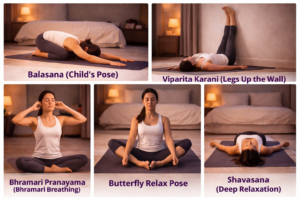
- Balasana (Child’s Pose) The practice begins with the practitioner sitting on the floor before leaning forward to the ground. The practitioner needs to position himself so that his forehead touches the floor. The practitioner has to stay in this position for five to ten breaths.
The practice instantly brings mental tranquility.
- Viparita Karani (Legs Up the Wall) The practitioner needs to lie down on the floor next to a wall. The practitioner needs to position his legs straight up to the wall. The practitioner should maintain this posture for a duration of five to ten minutes.
The practice enhances blood flow while it simultaneously decreases stress levels.
- The Butterfly Relax Pose requires you to lie on your back. The Butterfly position requires you to open your legs while keeping your soles together. The way you need to place your arms should be in a comfortable position.
The body achieves complete relaxation through this practice.
- Bhramari Pranayama (Bhramari Breathing) Close your eyes. Take a deep breath and make a humming sound (“Hummm”). You need to repeat the process between five and seven times.
- Shavasana (Deep Relaxation) The procedure starts with you lying down on your back in a flat position. You must release all tension from your body until it achieves total relaxation. Your breathing pattern should be the only thing that you concentrate on.
The most fundamental yoga pose for relaxation purposes stands as this particular position.
Rest more effectively through these five essential sleep strategies.
- The first sleep recommendation is to stop using your mobile device one hour before you need to sleep.
- The second sleep recommendation requires you to go to bed at the same hour every night.
- The third sleep recommendation requires you to eat a small meal for dinner.
- The fourth sleep recommendation requires you to maintain a silent and dark environment in your bedroom.
- The fifth sleep recommendation requires you to do bedtime yoga practice before your sleep time.
Benefits of Yoga for Sleep
Daily yoga practice during the time period of 15 to 20 minutes will provide you with these advantages.
People will fall asleep more quickly. People will sleep for longer periods with deeper sleep patterns. People will wake up in the morning feeling totally rested. The treatment results in decreased levels of stress and anxiety.
Key Takeaway
Sleep problems do not require expensive solutions because people can resolve their sleep problems through daily practice of “yoga for sleep” and minor lifestyle adjustments.
Conclusion
Daily yoga practice should begin today for people who want to achieve better sleep. The natural sleep improvement method provides safe results which will enhance your sleep quality over time. Your body requires proper sleep because it serves as the fundamental building block for maintaining good health.
Start today… and feel the difference yourself.
The section contains commonly asked questions and their answers.
- Does yoga really help you sleep?
The practice of yoga establishes a serene atmosphere which enables individuals to experience faster sleep onset.
- How long should one practice yoga before bed?
The practice of yoga for 15 to 20 minutes before sleep serves as an adequate pre-sleep routine.
- Is it necessary to practice yoga every day?
The path to successful results requires people to maintain a daily yoga practice.
- Can yoga completely cure insomnia?
The answer is yes because stress-related sleep problems show high success rates with this treatment.
- Which yoga poses are best for sleep?
The three postures of Shavasana Bhramari and Viparita Karani provide powerful sleep-inducing benefits.
- Can beginners also practice these yoga poses?
The postures provide all users safe access because they maintain simple design.
Read More –
Endocrine System and Yoga: Hormone Balance Through Yoga